History
"Believe me dear Father, there is seldom a day which passes, without a very loving thought, and a sincere prayer for S. Mary's, and many is the Holy Eucharist that has been offered for S. Mary's, her priest and people and for the dear friends who helped me establish Holy Mother Church, in a very old town even thirty years ago, where the Church's voice had never been heard..."
—From a letter from Father James Noble to Father John Crowell, Advent Sunday, 1916
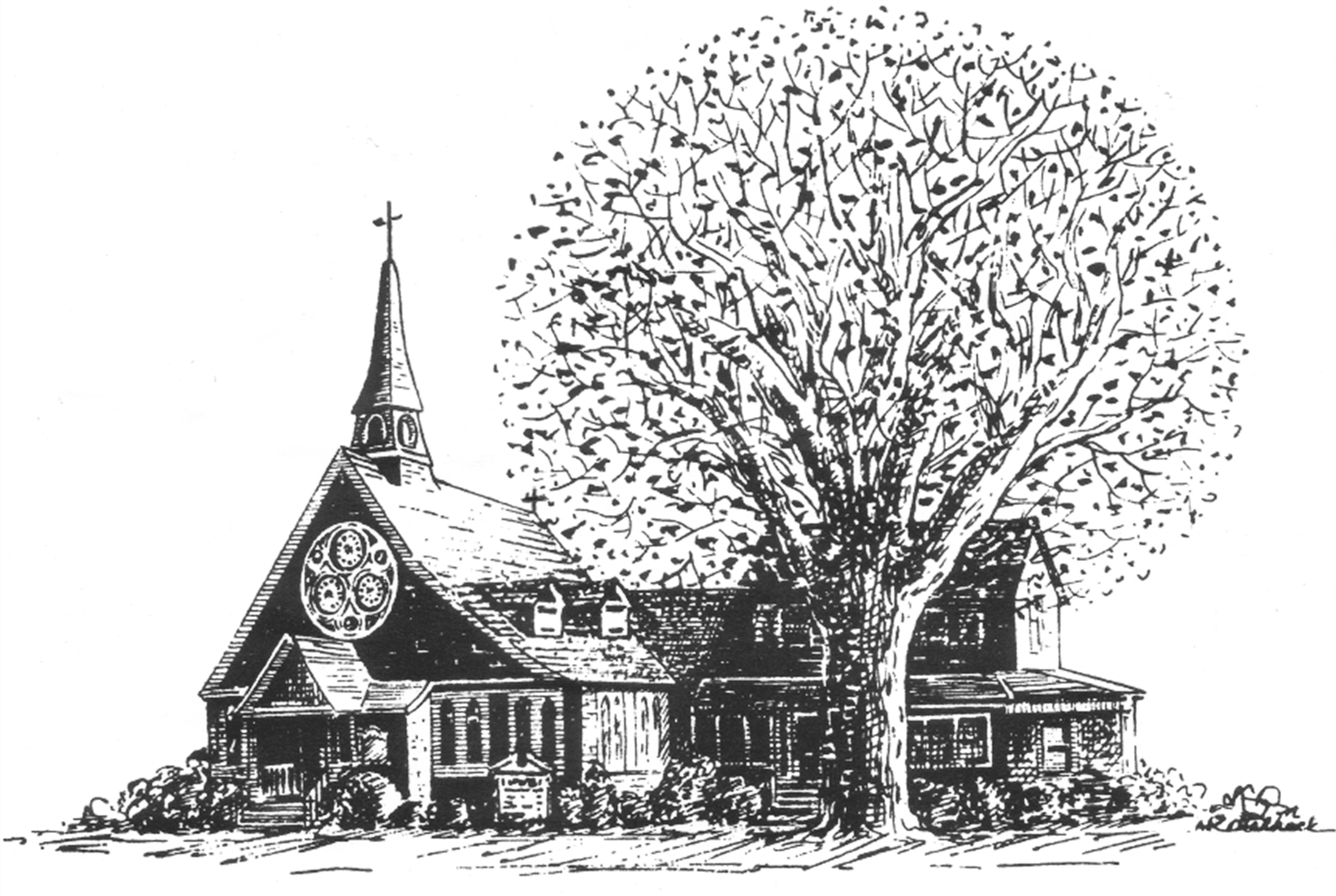
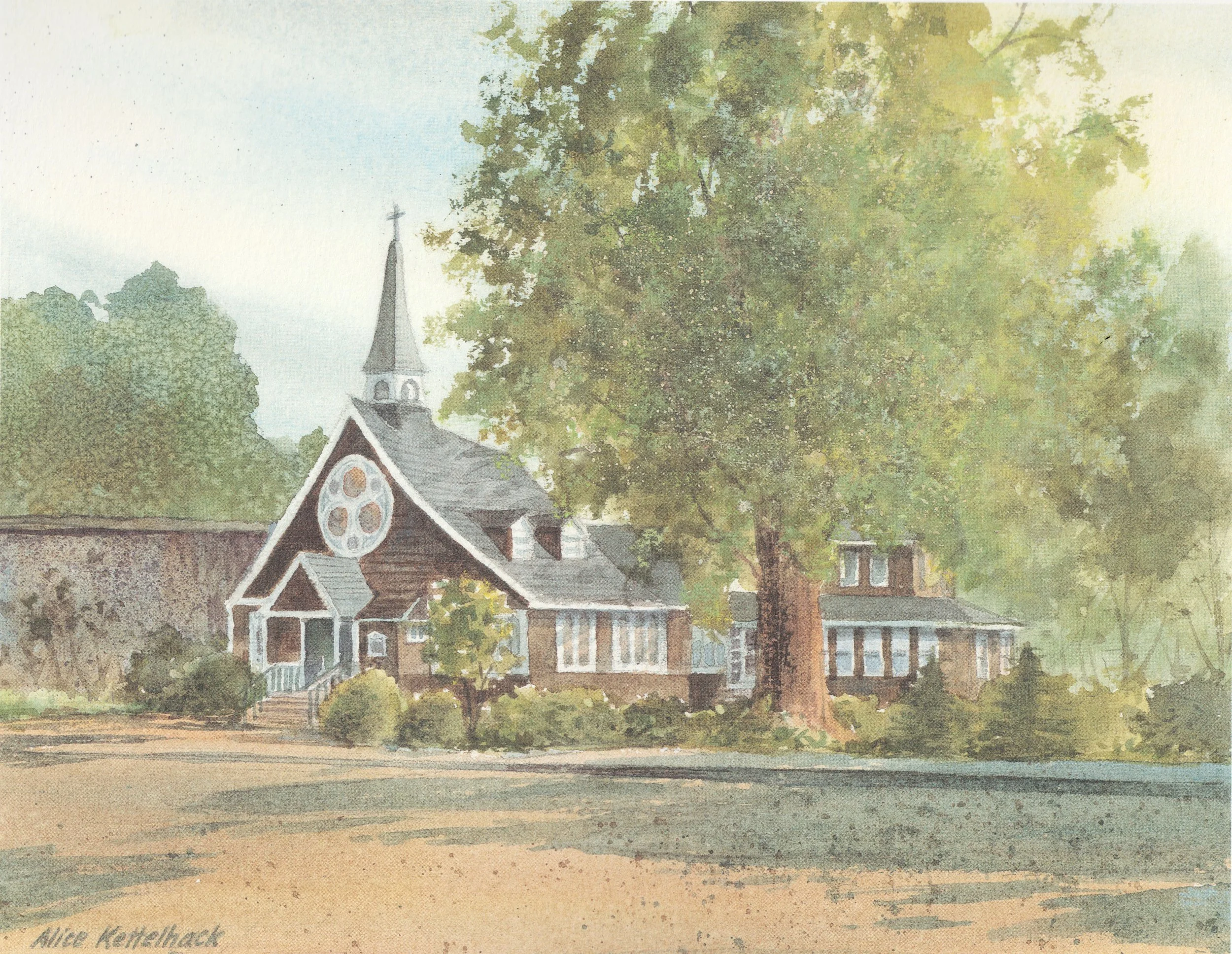
The story of St. Mary’s Church begins in 1886, when a small group of faithful Anglicans in Amityville sought to establish an Episcopal presence in the growing village. Their desire was first expressed at a service held in Liberty Hall on the west side of Broadway, organized through the efforts of local resident Mr. Kramer.
James Noble, then serving as a lay reader at St. Thomas’ Church in Farmingdale, was invited to assist. With the permission of Bishop Abram Newkirk Littlejohn of Long Island, services began in Amityville. The first service was held on the Feast of St. Andrew, November 30, 1886. The liturgy was Evensong, with the Rev. Dr. Jesse A. Locke officiating and James Noble reading the lessons.
This humble gathering marked the founding of what would become St. Mary’s Church.
1886: A Parish Born from Faith & Vision
Skinner cottage (originally owned by Elijah Chichester), the first meeting place of
Saint Mary’s Church at 33 Mill St. where it now stands, ca. 1908.
Humble Beginnings:
Worship in a cottage
In the early years there was no church building. Services were first held in Liberty Hall and later moved to a cottage on Avon Place made available by William Skinner.
The cottage quickly became the center of the fledgling congregation’s life. The first Sunday service was celebrated there on Easter Day, April 15, 1888. Confirmation was administered by Bishop Littlejohn on May 3 of that same year, and a parish school was established soon afterward.
William Skinner’s contribution to the parish extended far beyond the use of his house. He devoted himself to St. Mary’s for more than six decades, remaining active in parish life until his death in 1954. The cottage still stands today, having been moved to the south side of Mill Street, serving as a tangible reminder of the parish’s earliest days.
Building a Permanent Church Home
Recognizing that the congregation needed a permanent home, James Noble relocated to Amityville in January 1888 and immediately began planning for a church building.
In February 1888, a wooded parcel on the east side of what was then known as Amityville–Huntington Road (today Broadway) was purchased for $850. Ground was broken on March 6, 1888, and the church was laid out in the shape of a cross.
Construction proceeded rapidly under the direction of builder Wessley Ketcham. Within a matter of months the church was ready for worship. On August 6, 1888, parishioners processed from the Skinner cottage to the newly completed building, where the Rev. Dr. Jessup blessed the altar, books, and furnishings, thereby officially opening the church for services.
The first major feast day celebrated was the Feast of the Transfiguration. On that occasion, the Holy Eucharist was celebrated in the new church for the first time by a Rev. Fr. Moran. Edmund Rake, organist of St. John’s Church, Brooklyn, played for the service.
A 1907 postcard of Saint Mary’s Church with the parish hall still in its original location.
A later postcard showing the newly-constructed rectory where the parish hall used to be.
The new south aisle of the church is also visible.
Although the Rev. Jessup was the first priest-in-charge, much of the credit for founding the parish belongs to James Noble. Noble served simultaneously as Senior Warden and lay minister while helping establish regular worship, organize the congregation, and oversee construction of the church. He was ordained deacon in 1889 and priest in 1897. For these reasons, he is rightly remembered as the principal founder of St. Mary’s. St. Mary’s Church was formally consecrated by Bishop Littlejohn in 1889, one year after the church building opened.
Growth and Expansion (1892–1920)
As the parish matured, a series of improvements transformed the church campus.
In 1892, a bell was purchased for the church tower. Arriving the following year, the 667-pound bell quickly became a familiar sound throughout the village. For many years, residents of Amityville heard its peal before worship, celebrations, and special occasions.
The Parish Hall was constructed in 1900 and later relocated to make way for a new rectory built in 1909 at a cost of approximately $4,600. During the same year, the church itself was enlarged through the addition of a south aisle, made possible by a memorial gift from a parishioner honoring his parents.
Additional improvements followed:
Enlargement of the sacristy in 1910
Installation of the rood screen and reredos
Addition of a kitchen to the Parish Hall in 1916
Construction of a choir room and guild room beneath the rectory between 1917 and 1920
Installation of a new ceiling and hardwood flooring
Expansion of the kitchen facilities
The church campus gradually evolved into a thriving parish center capable of serving a growing congregation.
Music at the Heart of Parish Life
Music has been central to the life of St. Mary’s from its earliest days. One of the church’s first major purchases was a Vocalion organ, installed in July 1888. Manufactured by the New York Organ Company and acquired through the generosity of the women of the parish, the instrument represented an innovative blend of pipe-organ and reed-organ technology.
Though modest by modern standards, it was regarded as a beautiful and powerful instrument and played an important role in establishing the rich musical tradition that continues at St. Mary’s today.
The church’s musical tradition continued to develop throughout the twentieth century. In 1936, a large pipe organ acquired from a church in New Jersey was installed. This instrument served the parish until 1955, when it was replaced by a Baldwin electronic organ.
Additional organs followed over the decades, including instruments manufactured by Rodgers. Each generation contributed to maintaining the high standard of sacred music that has long characterized worship at St. Mary’s.
The Founding Leadership
Becoming A full-fledged Parish
By 1920 St. Mary’s had reached an important milestone. Having become financially stable and free of debt, the congregation was eligible to seek formal incorporation and admission into union with the Diocese of Long Island.
At the annual parish meeting held on December 15, 1920, parishioners voted to pursue this goal. The following year, in 1921, St. Mary’s was officially received into union with the Diocese, and Vedder Van Dyck became the parish’s first rector.
An interesting note from the minutes of that annual meeting reflects the changing society of the era. Parishioners voted that women should be permitted to vote at future annual parish meetings—a significant step that coincided with the broader women’s suffrage movement then transforming American civic life.
Postwar Growth & Modern Developments
The years following the Second World War brought further growth and development.
A garage was erected behind the Parish Hall in 1949. In the late 1970s, new oak pews were installed, giving the church interior much of the appearance familiar today. In 1978, another organ from a Brooklyn church was added to support the parish’s musical life.
In 1986, a new Chapel of St. Michael and All Angels and Columbarium were established in the undercroft and dedicated on the Feast of the Ascension, May 8. The columbarium created a sacred resting place for the cremated remains of parishioners and loved ones.
Around the same period, the parish acquired the Griffith family homestead on Avon Place as a new rectory. The former rectory was repurposed as office space, classrooms, and meeting rooms, expanding the church’s ability to serve both parish and community.
The Chapel of St. Michael & All Angels decorated for the all-night watch at the Altar of Repose following the
Maundy Thursday liturgy on April 2, 2026.
For nearly a century and a half, St. Mary’s Church has stood at the heart of Amityville.
Its Gothic church building, chapel, rectories, parish hall, and grounds have become familiar landmarks in the village. Yet the significance of St. Mary’s extends beyond architecture. The parish has served generations of worshippers through baptisms, confirmations, marriages, funerals, acts of charity, and daily prayer.
As Amityville has grown and changed, St. Mary’s has remained a constant witness to the Gospel and a place where people encounter God’s presence in worship, fellowship, and service.
What began with a small gathering in Liberty Hall in 1886 has grown into one of Long Island’s enduring Episcopal parishes.
St. Mary’s Today
The founding members of St. Mary’s could scarcely have imagined the generations that would follow them. Yet their vision, a church rooted in faithful worship, sacramental life, Christian education, sacred music, and service to the community continues today.
Our history is not simply a record of buildings, clergy, and dates. It is the story of countless faithful people who have offered their prayers, talents, and devotion to build a parish that remains a spiritual home for all who seek Christ.
Today, just as in 1886, St. Mary’s Church continues its mission of worshiping God, proclaiming the Gospel, and serving His people in Amityville and beyond.
The Future of St. Mary’s:
Preserving an Historic Landmark
for generations to come
When St. Mary’s was first established by a handful of faithful Episcopalians in 1886, they had hoped the community they were founding would blossom and flourish for the generations who would come after them. In that spirit, we likewise must keep ourselves focused on what lies ahead.
Within the last several years, the roofs of all the parish buildings have been replaced ensuring the longevity of our historic structures. The Parish Hall has been expanded to include accessible facilities, and in 2018 the church bell tower and historic bell underwent extensive restoration so that it may continue to beckon the faithful of Amityville to gather for worship.
These efforts reflect our congregation’s commitment not only to preserving buildings but also to preserving the legacy of faith they represent, and YOU can be part of our
on-going story:
Partake in the Sacramental life of the Church
A local Treasure
A living Legacy